How should I compare enlarged-prostate treatment options?
First confirm the cause of your urinary symptoms. Compare monitoring, medicines and procedures by suitability, expected benefit, risks and the follow-up each requires. A procedure offered by a clinic is not automatically the right choice for you.
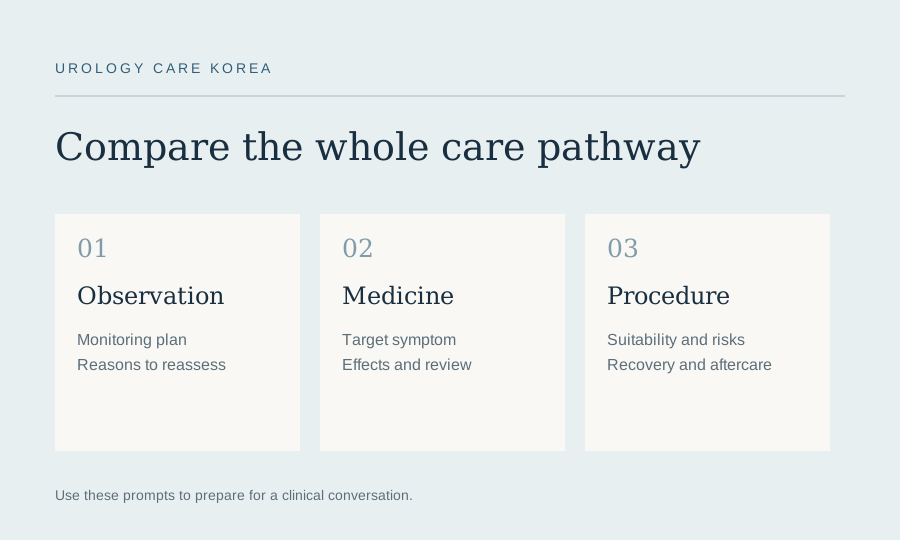
The best comparison starts with your diagnosis
An enlarged prostate does not automatically require a procedure. Depending on symptoms, findings and complications, the choices may include monitoring, medication or an intervention. The right discussion starts with whether prostate enlargement is actually causing the problem and how much it affects daily life. A treatment name on a clinic website cannot establish which option is suitable for you, even when that procedure sounds less invasive or has an appealing recovery description.
If you are planning care in Korea, separate three decisions: whether treatment is needed, which treatment fits your findings, and where follow-up will take place. Write down your priorities before a consultation. Better sleep, a stronger urine stream, avoiding a long-term medicine, preserving sexual function and reducing repeat procedures may all matter, but different options involve different trade-offs. Ask the clinician to explain those trade-offs for your own circumstances.
Symptoms are a reason for assessment, not proof of BPH
Benign prostatic hyperplasia, often shortened to BPH, refers to noncancerous prostate enlargement. It can contribute to a slow stream, difficulty starting urine, frequent urination and a feeling of incomplete emptying. However, urinary symptoms can have other causes. A diagnosis should not be assumed from age or from a symptom checklist alone. The assessment may consider infection, bladder function and other explanations before attributing the problem to the prostate.
Tell the clinician which symptom bothers you most and which changes are new. Bring earlier results and a medicine list. Ask whether the findings suggest obstruction, a bladder storage problem or more than one issue. That distinction matters because a procedure designed to open the urinary passage may not address every source of urgency or night-time urination. Understanding the expected target of treatment helps prevent an overly broad expectation of what one intervention can achieve.
Agree what needs testing before comparing procedures
A history, examination and selected tests help define the problem. Depending on your situation, the evaluation may include urine testing, a urine-flow measurement, measurement of urine left after voiding or prostate imaging. A PSA discussion may be appropriate, but PSA needs interpretation alongside other information. Ask which findings are required to judge the proposed procedure and whether existing tests are recent and complete enough to use.
Request a simple explanation of the results: what is known, what remains uncertain, and how that affects the shortlist of treatments. If two clinics recommend different approaches, compare the clinical reasoning rather than just the names of the technologies. Check whether they considered the same records and whether either recommendation depends on a test that has not yet been done. An informed second opinion is easier when you have the actual reports and proposed treatment plan.
Monitoring is an active option for some people
When symptoms are mild or not very troublesome and there are no concerning complications, monitoring may be reasonable. This is a plan to observe the condition with agreed review points, not an instruction to ignore it. Ask which changes should trigger another appointment, whether any tests need repeating and who will assess progress. The decision depends on clinical findings as well as how much the symptoms interfere with your life.
Keep the plan specific enough to follow. For example, ask how to record changes in sleep disruption or urinary difficulty and when to report them. Discuss fluid patterns, caffeine or other habits with the clinician rather than making extreme restrictions yourself. If observation is the preferred choice, you should still understand what would make medication or intervention worth reconsidering. Request a written review plan if you will be returning to another country after the consultation.
Medicines offer different mechanisms and trade-offs
Some medicines relax muscles around the prostate and bladder outlet; others act on the hormonal processes associated with prostate growth. Tamsulosin is an example of the first approach. Finasteride is an example of the second and can take months to reach its full effect. A clinician may consider a combination or another medicine according to the symptom pattern. Do not choose or change a prescription from a comparison article.
Ask what improvement to expect, when to judge the response and which side effects deserve contact with the prescriber. Sexual effects, dizziness or interactions may matter depending on the medicine and your health. Bring all existing prescriptions to the discussion, including treatments for blood pressure or erectile difficulties. If you previously tried a medicine, explain the dose, duration and reason you stopped. A short or poorly tolerated trial can mean something different from a fully assessed treatment failure.
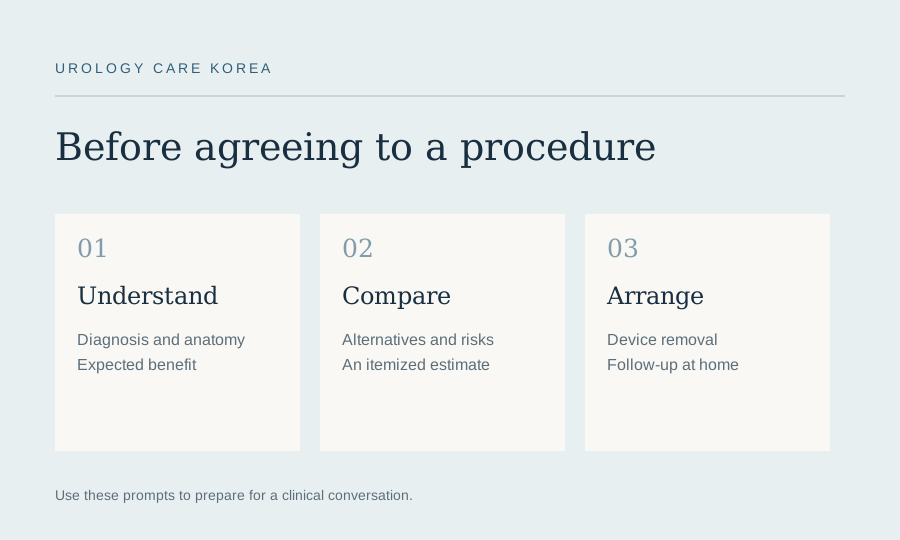
What a prostatic urethral lift is intended to do
A prostatic urethral lift, commonly known by the UroLift brand, uses implants to hold prostate tissue away from the urinary passage. Its purpose is to improve the space available for urine to flow rather than remove tissue in the same way as resection surgery. Whether that approach is appropriate depends on the individual assessment. Ask the clinician to explain how your prostate anatomy and urinary findings affect suitability.
If preserving ejaculation or minimizing disruption is a major priority, raise that directly, but do not interpret a general promotional statement as a personal guarantee. Ask about discomfort, bleeding, infection, temporary urinary difficulties, catheter possibilities and the chance of further treatment. Request information about the implants, including any records you should retain for future care. Also ask which alternatives the clinician would recommend if your findings do not fit this procedure, and why.
What water-vapor treatment is intended to do
Water-vapor therapy, often called Rezūm, uses steam to treat prostate tissue contributing to obstruction. It is a different mechanism from physically lifting tissue with implants. The comparison should therefore cover the expected course after treatment as well as the procedure itself. Ask how the clinician will assess response and which temporary symptoms, follow-up visits or catheter arrangements may apply to the proposed plan.
For a visitor, the practical question is not simply how quickly the appointment can be performed. Ask when it is appropriate to travel, how problems would be managed and what support is available if recovery takes longer than expected. Request a written account of potential benefits, relevant adverse effects and alternatives. If a clinic offers both water-vapor therapy and another intervention, ask which individual findings favor one approach rather than treating the choice as a matter of brand preference.
Tissue-removing procedures may be part of the discussion
Procedures such as transurethral resection of the prostate, or TURP, remove tissue to relieve obstruction. Laser-based approaches and other operations may also be considered in suitable cases. These should be compared in terms of the clinical reason for treatment, expected benefit, anesthesia, recovery and complications. A smaller-sounding procedure is not automatically the most appropriate choice, and a more substantial operation is not automatically necessary because symptoms are frustrating.
Ask the surgeon which operation is proposed, what tissue is treated and what effect it may have on ejaculation, urinary control and future investigations. Discuss bleeding, infection, retention and the possibility of additional treatment. If tissue will be examined, ask how you will receive the result. The choice also depends on your overall health and other medicines. A consultation should make those individual considerations explicit rather than presenting surgery as a uniform package.
Compare outcomes using the same questions
Use a single set of questions for each option: Which of my symptoms is likely to improve? How soon should I expect to notice change? What can remain unchanged? What is the possibility of another procedure? What are the important short-term and longer-term risks? Ask how the clinician estimates these outcomes for someone with your findings, and distinguish published evidence from the clinic's own experience or promotional material.
Keep track of the answer in a small comparison note. Include the reasons an option is unsuitable as well as the reasons it is offered. If an outcome matters especially to you, ask about it even if the consultation materials do not mention it. For example, a treatment discussion centered on urine flow may not answer your question about night-time waking or ejaculation. Clarifying the goal is often more useful than comparing a long list of device features.
Plan recovery before committing to treatment
Ask for a recovery plan matched to the actual procedure. It should cover medicines, catheter care if relevant, activity limits, work, sexual activity, follow-up and symptoms requiring urgent help. Do not assume that being discharged the same day means you can immediately fly home or resume all activities. Ask which instructions are routine and which depend on your health, test results or progress after treatment.
For care abroad, identify the clinician who can help after you leave. Request an operation summary, medication details and any implant information in a usable format. Clarify whether follow-up can be coordinated remotely and which concerns need physical examination. Keep your travel bookings flexible until the treating clinician advises that the plan is reasonable. A lower initial procedure price can lose practical value if it leaves an unresolved follow-up need that was never discussed.
Understand cost and consent as separate decisions
Request an itemized estimate for assessment, treatment, anesthesia where relevant, medicines, catheter-related care and scheduled review. Ask what happens financially if the procedure is postponed after examination, if extra testing is required or if an unplanned visit becomes necessary. This platform does not publish a universal BPH price because treatment scope and individual needs differ. Compare written estimates for the same included services rather than treating headline prices as equivalent.
A financial estimate is not clinical consent. Before deciding, you should understand the reason for the intervention, realistic benefits, material risks and alternatives, including continued medication or monitoring when appropriate. Ask for time to review an elective recommendation and consider another opinion if the explanation remains unclear. If you feel pressured to select a procedure before adequate assessment, step back and request the reasoning and records needed to make an informed decision.
Partner clinics relevant to prostate questions
Khan Urology Clinic's international site describes a prostate and urinary-condition focus, including UroLift, and identifies Dr. Cheol-Young Yoon as chief director. Gangnam St. Mary's Urology Clinic lists BPH care, water-vapor treatment and prostatic urethral lift among its services. These two listed partners provide relevant starting points for asking how an enlarged-prostate consultation would be organized and which assessments are needed before discussing treatment.
Review their international websites and take the same questions to each consultation. Their inclusion here is based on the supplied partner roster and advertised service relevance, not a ranking or an assertion that either procedure is suitable for you. Do not delay urgent care while comparing them: inability to pass urine requires prompt assessment. For an elective decision, the useful endpoint is a documented clinical rationale, an understandable estimate and a workable follow-up plan.
- NIDDK: Enlarged prostate ↗
- NHS: Enlarged prostate ↗
- NHS: TURP ↗
- NHS: Tamsulosin ↗
- NHS: Finasteride ↗
- NIDDK: Treating urinary retention ↗
- Khan Urology Clinic ↗
- Gangnam St. Mary’s Urology Clinic ↗
Sources checked 31 October 2026. Educational content; not independently medically reviewed.