How do I prepare for a urology visit in Korea?
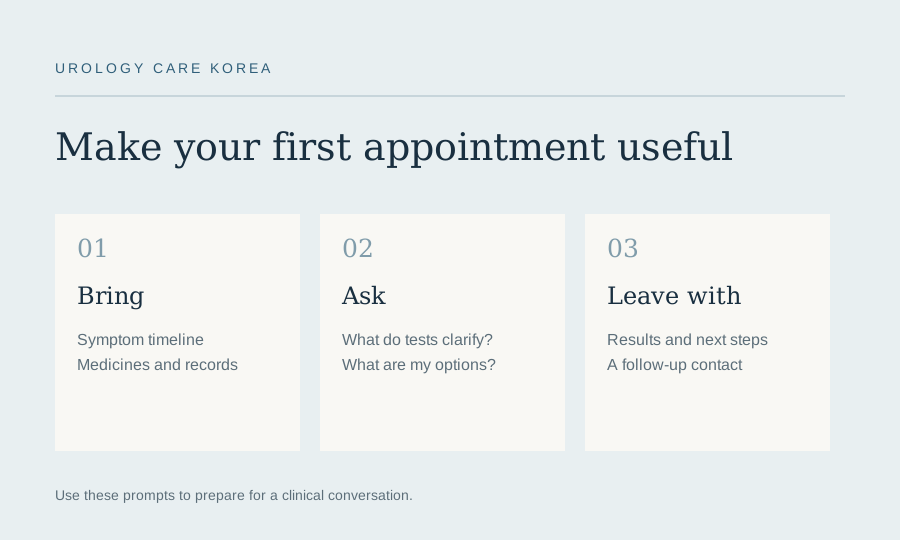
Choose a clinic that assesses your concern, confirm consultation language and fees, and bring your symptom timeline, medicines and previous reports. Before leaving, ask when results will be ready and how follow-up will work.

Start with the problem you want help with
A first urology appointment is usually a chance to explain your symptoms, review your history and decide which examinations or tests are useful. It does not commit you to a procedure. If you are visiting Korea, arrange the assessment around the medical question first, then work out travel and follow-up. If you live in Korea, the same approach helps you find a service that fits your needs without purchasing an unnecessary package.
Write one sentence describing your main concern: difficulty starting urine, leakage during exercise, repeated infections, pain, a previous abnormal result or a prostate treatment question. Then write what you hope to understand by the end of the visit. A clear goal makes it easier to judge whether the proposed consultation and clinic are relevant. You do not need to arrive knowing the diagnosis or the name of a treatment.
Know when a routine appointment is not enough
Sudden inability to pass urine, particularly with a painful or swollen lower abdomen, needs immediate medical assessment. Do not wait for an overseas consultation or a preferred clinic appointment. Urinary retention can require prompt bladder drainage by a healthcare professional. Blood in urine also needs medical evaluation, even if it occurs once or does not hurt. A directory cannot assess the cause or determine that waiting is safe.
Fever or chills with urinary symptoms, pain in the back beneath the ribs, vomiting or feeling markedly unwell may require urgent care. New symptoms during pregnancy also deserve prompt clinical advice. When contacting a service, state these details at the beginning rather than putting them after a long travel enquiry. If symptoms become severe or rapidly worsen, use local urgent or emergency care instead of continuing to compare routine appointments online.
Choose by clinical fit, then by practical arrangements
Urology includes different problems, and a clinic's broad name does not establish that every service is available there. A prostate-focused consultation may be appropriate for an enlarged-prostate question. Persistent leakage or urinary urgency may require someone who regularly evaluates bladder control and women's urinary health. A cancer-related concern may need investigation and referral beyond the services of a community clinic. Ask where care would continue if the findings require a hospital.
Use the clinic profile to identify advertised services and named clinicians. Then confirm who would see you, whether the appointment is diagnostic or procedure-focused, and whether your previous reports can be reviewed beforehand. A photograph, a partner relationship or an attractive treatment description does not prove suitability for your individual case. The most useful response is one that explains the assessment process and its limits before asking you to make a treatment decision.
Prepare a concise symptom timeline
Make a brief timeline showing when the problem started, whether it is constant or intermittent, and whether it has changed. Include symptoms you might otherwise leave out: discomfort, blood, waking at night, straining, incomplete emptying or leakage. Describe how the problem affects everyday life. For example, needing to leave meetings repeatedly or avoiding exercise gives the clinician a clearer picture than saying the symptoms are simply bad.
Keep observations separate from assumptions. Write that you pass urine frequently rather than deciding it must be an infection. Note previous episodes and treatments, including whether improvement lasted. If a test was abnormal, bring the actual report rather than relying on a remembered number. Do not intentionally alter your routine to make symptoms look better for the visit. An honest account helps the clinician interpret the problem in the context of your normal day.
Bring records that can answer a clinical question
Useful records may include previous urine tests or cultures, imaging reports, prostate investigations, operation notes and a current medicine list. Include the original date, units and reference ranges where possible. If imaging is important, ask whether the clinic needs the actual image files as well as the written report, and which transfer method it accepts. Sending a compressed screenshot of a report may leave out details the clinician needs.
List prescribed medicines, non-prescription products, supplements and allergies. Note the dose and reason for each medicine if you know them. Do not stop treatment, antibiotics or blood-thinning medication to prepare for an appointment unless your treating clinician gives specific instructions. Keep a copy of your records yourself, particularly if more than one clinic is involved. Ask how the receiving clinic protects transferred documents; avoid posting personal medical information in public comments or review forms.
Clarify communication and privacy before the visit
An English-language website is useful, but it does not by itself establish which members of staff can discuss complex medical information in English. Ask whether the consultation, test explanation, consent discussion and written instructions can all be provided in a language you understand. If an interpreter is needed, confirm availability, cost and whether that person can attend the entire clinical discussion rather than only the reception process.
You can ask about a chaperone, clinician preference or privacy arrangements for an intimate examination. Explain access requirements or anxiety about a particular examination in advance. A family member may help with practical arrangements, but decide which information you want shared and whether you want part of the consultation alone. Before signing consent, ask for unfamiliar words to be explained. A decision can wait for clarification unless the clinical situation requires urgent treatment.
Understand the purpose of possible tests
The clinician chooses tests according to the symptoms and examination. A urine sample may help investigate infection or blood. A urine-flow test records how urine is passed. An ultrasound after urinating can measure urine remaining in the bladder. These tests answer different questions; one normal result does not necessarily explain every symptom. Ask what the test is looking for and how its result would change the next step.
Some people need additional investigation, such as cystoscopy, which allows a clinician to inspect the bladder through a thin instrument. This is not automatically part of every first visit. Ask about discomfort, preparation, alternatives and recovery for any proposed procedure. Confirm separately whether fasting, a comfortably full bladder, an escort or changes to your schedule are required. Preparation depends on the actual test, so general website advice should not replace the clinic's individual instructions.
Discuss prostate testing without assuming the result
If a prostate concern is part of the visit, the clinician may discuss symptoms, examination and a PSA blood test. PSA can help investigate prostate conditions, but it is not a stand-alone diagnosis of cancer. A raised result can lead to further assessment; an apparently reassuring result also needs interpretation in context. Ask why the test is recommended for you and what the possible results would mean.
Bring earlier results with their dates so the discussion is based on a record rather than a single remembered value. Tell the clinician about recent procedures, infections and relevant medicines. If more investigation is recommended, clarify who will arrange it and how quickly it should happen. Do not schedule travel around an assumed same-day answer. The first appointment may establish a plan for investigation rather than settle the entire question.
Request a written estimate with clear boundaries
There is no single meaningful price for a urology visit that includes every possible problem. Ask for the consultation fee and an explanation of separately charged tests, imaging, medicines and procedures. If a package is offered, request the included items and the circumstances in which extra charges arise. Ask whether a second appointment to explain results is included and whether interpretation or translated records carry an additional fee.
Keep the clinical and financial decisions linked: what question does each paid test answer, and what would happen if you postponed it? For insurance, confirm coverage with your insurer using the actual proposed services and provider details. A clinic's ability to issue a receipt is not proof that your policy will reimburse it. Request the documents you need before paying, and keep written estimates, receipts and the final clinical summary together for your own records.
Leave with a follow-up plan you can use
Before leaving, ask what the current working diagnosis is, what remains uncertain and when results will be ready. Confirm how you will receive them and who will explain an abnormal result. If medication is prescribed, request the generic name, instructions, relevant side effects and what to do if it does not help. Ask when the treatment should be reviewed rather than assuming the prescription is a permanent solution.
Visitors should discuss follow-up before arranging a return flight, especially if a procedure, catheter or pending investigation is involved. Ask which problems require an in-person review and who will manage them after you leave Korea. A useful discharge summary states what was done, the results, current medicines and the next recommended action. Remote communication can be helpful, but ask about its limits and whether a clinician in your home country should take over ongoing care.
Listed clinics to consider for a relevant consultation
Gangnam St. Mary's Urology Clinic advertises prostate care, urinary incontinence, kidney stones and other urological services on its international website. It is a relevant starting point for reviewing the scope of a general urology consultation. Khan Urology Clinic describes a prostate and urinary-condition focus and lists Dr. Cheol-Young Yoon as its chief director. Its service information may be useful if your main question concerns an enlarged prostate.
For women's urinary concerns, NEOU Female Urology Clinic advertises urinary tract infection and incontinence care and identifies Director Kim Joo-Nam. Review the relevant international website and ask whether your symptoms fit its current consultation service. These clinics come from the platform's supplied partner list. Inclusion reflects that roster and advertised clinical relevance, not an independent ranking, a guarantee of results or a substitute for your own medical assessment.
Questions worth taking into the consultation
Ask: What are the likely explanations for my symptoms, and what must be ruled out? Which test is needed now, and which can wait? What are the benefits and drawbacks of the available options? What happens if I choose observation? How will we know whether treatment is working? Write the answers in your own words and ask the clinician to correct anything you have misunderstood.
You can also ask for time to consider an elective procedure, a copy of your results and an explanation of when a second opinion may be useful. If you are worried about a particular outcome, such as sleep, continence, sexual function or travel, say so directly. A useful appointment ends with a shared next step, even when further testing is needed. The aim is an understandable plan that fits your condition and circumstances, rather than a decision made under pressure.
- NIDDK: Diagnosing urinary retention ↗
- NIDDK: Symptoms and causes of urinary retention ↗
- NHS: Urinary tract infections ↗
- NHS: PSA test ↗
- NHS: Cystoscopy ↗
- Gangnam St. Mary’s Urology Clinic ↗
- Khan Urology Clinic ↗
- NEOU Female Urology Clinic ↗
Sources checked 31 October 2026. Educational content; not independently medically reviewed.