What should I prepare for an urgency or leakage consultation?
Describe when symptoms happen, what triggers leakage and whether you have pain or difficulty emptying. Bring a bladder diary if requested, previous results and a medicine list. Ask how assessment will distinguish possible causes before choosing treatment.
You do not need to accept leakage as normal
Urinary leakage and sudden urgency are reasons to seek an assessment, even when the symptoms have developed gradually. The first aim is to understand the pattern and its cause. Treatment depends on that assessment; it may begin with measures such as supervised pelvic floor training or bladder training rather than a procedure. A clinic visit is an opportunity to explain what is happening and discuss options, not a commitment to surgery.
If you are arranging care in Korea, describe the urinary symptoms in your initial enquiry instead of asking for a particular device or operation. Write down what the problem stops you doing comfortably: exercising, sleeping, commuting, attending meetings or being intimate. Those details help set useful goals for treatment. You do not have to wait until symptoms are severe, and you do not need to minimize them because you feel embarrassed about discussing them.
Describe the pattern before choosing a label
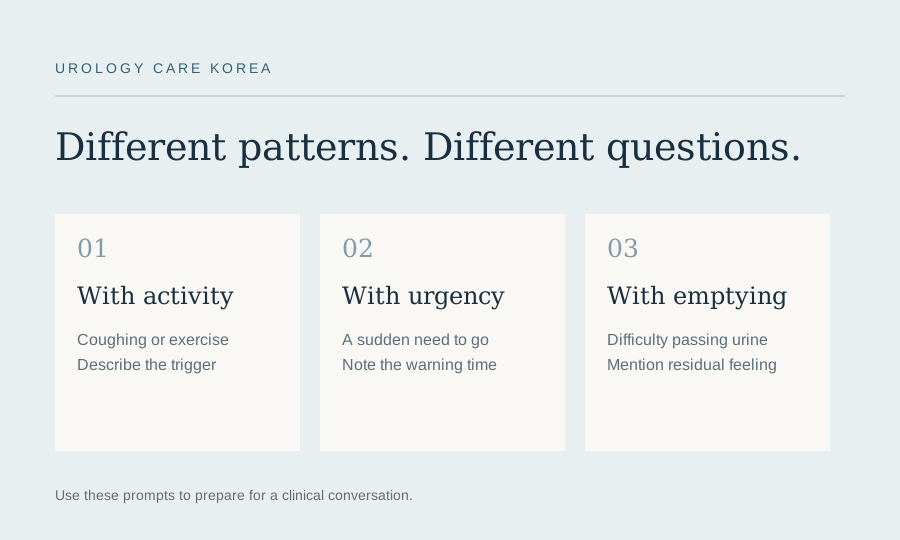
Leakage with coughing, laughing, lifting or exercise can suggest stress incontinence. Leakage associated with a sudden compelling need to urinate is a different pattern, often described as urgency incontinence. Some people experience both. Difficulty emptying the bladder can also be associated with leakage. These descriptions help organize the conversation, but they do not establish a diagnosis on their own or show which treatment will be most helpful.
Use ordinary language if the medical terms feel confusing. Tell the clinician what you were doing, whether there was a warning urge and whether you could reach the toilet. Mention changes over time, nighttime symptoms, pain and any sensation of incomplete emptying. Explain if the pattern differs at work, during exercise or when traveling. A description of several real situations is usually more informative than choosing a diagnosis from a website before you have been assessed.
Recognize symptoms that need prompt care
A routine bladder-control appointment is not the right place to wait out sudden inability to urinate. Seek immediate assessment if you cannot pass urine, especially with lower abdominal pain or swelling. Urinary symptoms with fever, chills, back pain below the ribs, vomiting or feeling very unwell may require urgent care. Blood in urine needs medical evaluation rather than being attributed automatically to a familiar bladder problem.
Tell the clinician promptly if you might be pregnant or if symptoms are new during pregnancy. Do not assume every episode of urgency is the same as a previous infection. If you have received antibiotics before, bring the records and explain whether testing was done, but do not use leftover medicine to replace an assessment. When symptoms are worsening, prioritize appropriate local care rather than waiting until a planned trip or comparing several elective treatment offers.
A bladder diary can make the visit more useful
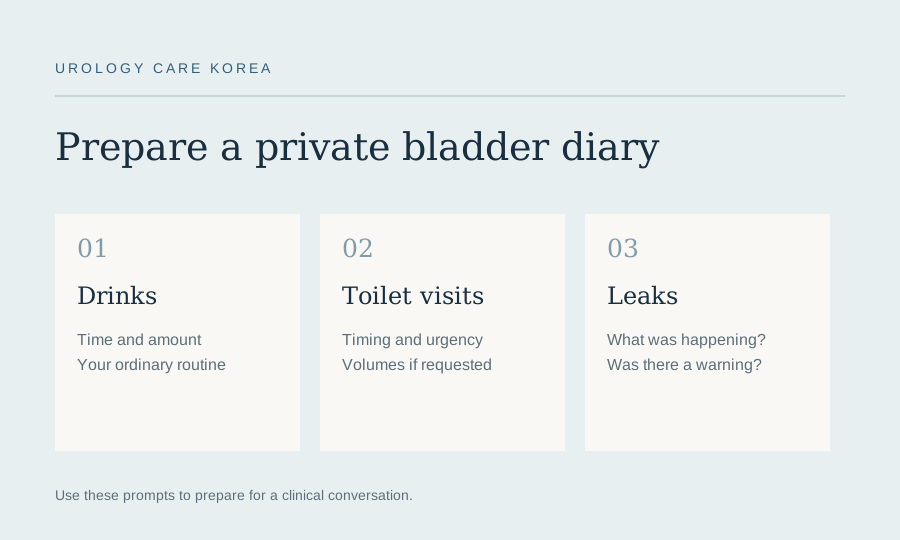
A clinician may ask for a bladder diary covering several days. Record when and how much you drink, trips to the toilet, urgent sensations and leakage episodes. Where practical, note urine volumes and what you were doing when leakage occurred. The purpose is to show patterns in ordinary life. Follow the clinic's format if it provides one; a clear paper record can be as useful as an app.
Choose days that reflect your routine, and note any unusual circumstances such as travel or illness. Do not deliberately drink far less to improve the record. If measuring every episode is impractical, say which parts are estimates rather than inventing precise numbers. Keep the record private and share it through the clinic's approved route. A diary is information for the consultation; it is not a self-diagnostic score or a reason to delay care for concerning symptoms.
Bring the parts of your history that matter
Useful background includes previous pregnancies and births, pelvic surgery, urinary infections, menopause-related changes, bowel symptoms and relevant neurological or other medical conditions. List all medicines and supplements, including products bought without a prescription. Bring previous urine results and reports from earlier investigations if available. You do not need to decide which detail explains the problem; the clinician can consider how the pieces fit together.
If an earlier treatment helped, describe what improved and for how long. If it caused discomfort or other problems, explain that too. Distinguish an exercise program taught and reviewed by a professional from exercises attempted from an online video, because the next discussion may be different. Write down your current priorities and any concerns about examination or treatment. That preparation helps you participate in the appointment even if talking about intimate symptoms feels difficult in the moment.
Ask what the assessment will involve
The consultation usually begins with symptoms and history, and the clinician may recommend examination or urine testing. A pelvic examination can help assess relevant findings, and a residual-urine test may be useful when incomplete emptying is suspected. Additional investigations depend on the clinical question. More testing is not automatically better; ask what each proposed test would clarify and whether its result would alter the treatment plan.
You can ask for an explanation before an intimate examination and discuss a chaperone or other comfort requirements. Confirm the clinician and language arrangements when booking if these affect your decision. If you are unsure about a proposed test, ask about alternatives and whether it can be deferred safely. Do not feel obliged to understand every technical word immediately. The important point is to leave knowing what was found and how that finding relates to the next recommended step.
Conservative care should be a real plan
Non-surgical approaches may include advice about drinking patterns, supervised pelvic floor muscle training and bladder training, depending on the type of problem. These approaches are not interchangeable. A program should explain what you are working on, how to do it correctly, when to review progress and what counts as a useful improvement. Ask for guidance matched to your assessment rather than simply increasing the number of exercises you perform.
If travel is involved, ask how the plan can continue after you return home. A short visit may be enough to begin assessment but not to judge a course of training. Find out whether follow-up can be coordinated and whether you should work with a clinician near home. If an exercise causes pain or symptoms change, seek advice rather than forcing yourself through it. Practical support and reassessment matter more than a promise that one standard routine works for everyone.
Medicines need a review point and a safety discussion
Medicines may be considered for some forms of urgency or bladder-control problems when appropriate. Ask what symptom the medicine targets, how long to try it and which side effects should prompt contact with the prescriber. Tell the clinician about other medicines and any difficulty emptying your bladder. The choice should reflect your medical history and the diagnosis, not just the fact that you would prefer to avoid a procedure.
Before leaving, confirm the generic medicine name and obtain written instructions in a language you understand. If you are traveling, ask how repeat prescribing and monitoring will work. Do not assume a medicine can be purchased or continued in the same way in every country. Arrange a review rather than continuing indefinitely without checking the response. If the first option does not help, the next step may be reassessment or another approach instead of automatically escalating to surgery.
Procedures require a diagnosis-specific comparison
Procedures used for stress leakage differ from those used for urgency symptoms. If an intervention is proposed, ask which aspect of your problem it is intended to address and which symptoms may remain. Discuss non-surgical alternatives, likely benefit, recovery and the possibility of further treatment. If you may want a future pregnancy, raise that before making a decision because it can affect the discussion about timing and options.
Where a sling, tape or other implant is proposed, ask what material is used, whether it remains permanently and which complications need particular attention. Potential issues can include persistent pain, urinary difficulties and implant-related problems, depending on the procedure. Request specific information rather than assuming that the words minimally invasive mean risk-free. Also ask who would assess a complication after you leave Korea and whether the clinic can provide a complete procedure record for another treating clinician.
Compare the care pathway, not just a treatment package
When reviewing clinics, compare who assesses you, what investigations are proposed, how treatment is selected and how progress is followed. Ask whether the service offers the type of care relevant to your symptoms and where you would be referred if another specialty is needed. A clinic that advertises women's health may cover several different services; that broad description does not show that every urinary problem can be managed there.
Request an itemized estimate separating the consultation, tests, treatment, medicines and follow-up. Ask about interpreter arrangements, translated records and any additional charges. If a package contains treatments unrelated to your stated urinary concern, ask why they are included and whether they are optional. Your budget comparison is more useful when the clinical scope is the same. A low advertised price cannot tell you whether the proposed pathway answers your medical question or provides adequate aftercare.
Relevant partners for a women’s urinary consultation
NEOU Female Urology Clinic advertises urinary tract infection and incontinence care on its international website and identifies Director Kim Joo-Nam. It is a relevant listed partner to consider when reviewing consultation options for women's urinary symptoms. Gangnam St. Mary's Urology Clinic also lists urinary incontinence and women's urological care. Review the current service pages and ask whether the clinician's assessment pathway fits your particular symptoms and previous treatment history.
These suggestions are restricted to the platform's supplied partner list and are based on advertised service relevance. They are not an independent quality ranking or a guarantee that a particular treatment will be offered or beneficial. Ask the same practical questions whichever clinic you choose: who will assess me, which tests may be useful, what alternatives are available and how will follow-up work? The answer should be specific enough to help you plan the next step without pressure.
Decide how you will measure improvement
Choose goals you can describe: fewer leaks during a walk, less urgency at work, better sleep or more confidence using public transport. Discuss whether those goals are realistic and how the clinician will evaluate progress. Keep a simple record if recommended, but avoid turning every day into a test. Ask when to seek another appointment if the plan is not helping, and which new symptoms should lead to earlier assessment.
Before leaving Korea, obtain the findings, treatment plan and follow-up instructions in a form you can share with your usual clinician. If you live in Korea, identify the next appointment and the contact route for questions. Managing urinary symptoms may involve adjustment over time, so a clear review plan is part of the treatment itself. You should know what you are trying, why you are trying it and what will happen if it is not enough.
- NHS: Urinary incontinence overview ↗
- NHS: Diagnosing urinary incontinence ↗
- NHS: Non-surgical treatment ↗
- NHS: Surgery and procedures ↗
- NHS: Urinary tract infections ↗
- NEOU Female Urology Clinic ↗
- Gangnam St. Mary’s Urology Clinic ↗
Sources checked 31 October 2026. Educational content; not independently medically reviewed.